Virtual Address for Mobile Food Trucks: Permits and Mail
Date Published :
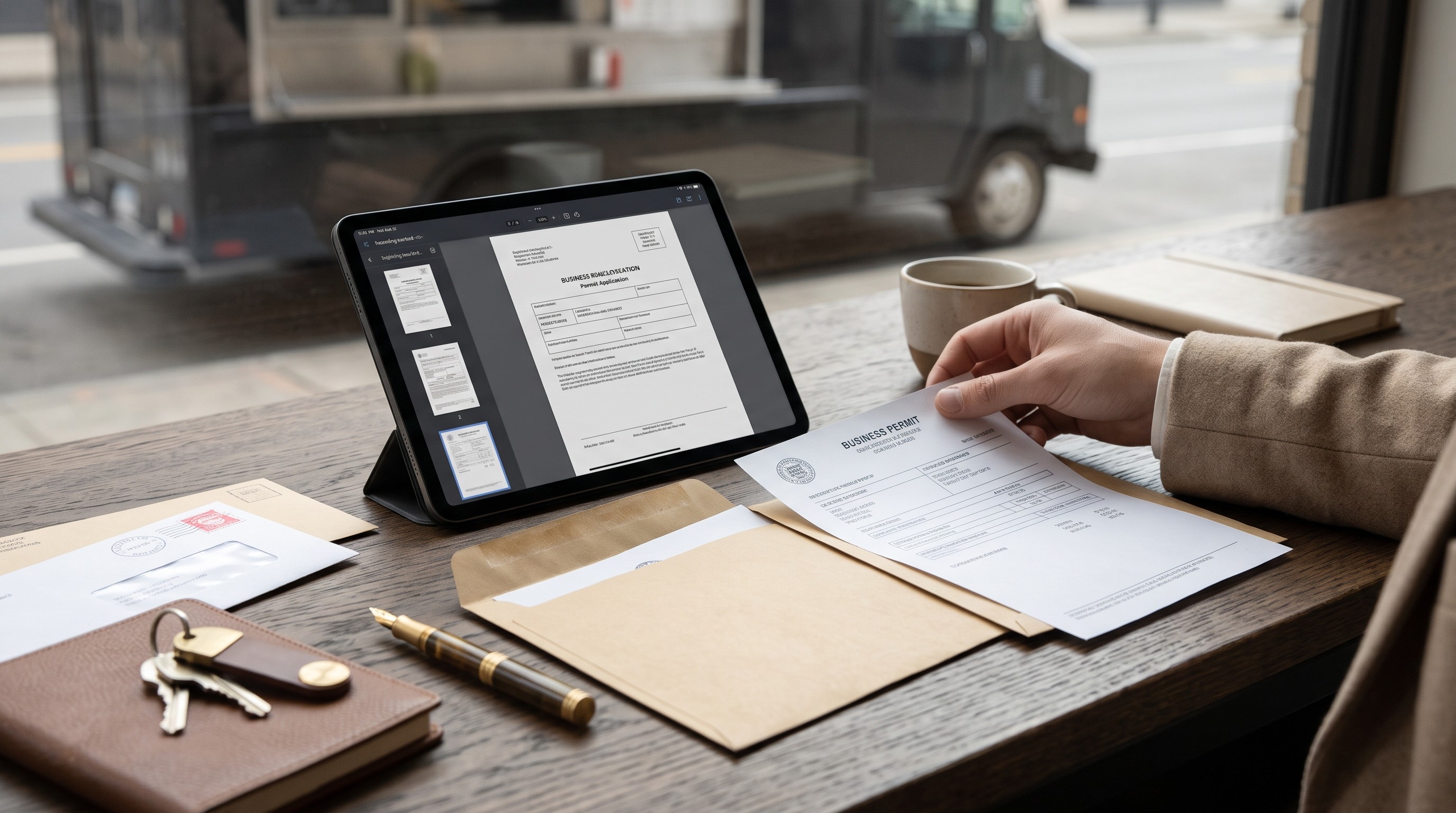
Mobile food truck operators face a unique legal contradiction: your business moves every day, but city regulations demand you stand still on paper. To secure permits, manage vendor licenses, and satisfy health department oversight, local agencies require a stable commercial address. Using your home address exposes your family's private residence on public vendor registries. Relying on a standard P.O. Box usually results in rejected paperwork because government regulators typically demand a verifiable physical street location.
A dedicated commercial virtual address solves this dilemma. It provides mobile vendors with a permanent physical street address to receive essential mail, satisfy licensing requirements, and digitize important postal records while keeping their kitchens fully mobile.
Why mobile food businesses struggle with street address rules
When you launch a food truck, your operational world is defined by commissary kitchens, propane inspections, and rotating event parking. The administrative world, however, still runs on twentieth-century paperwork.
City licensing boards, county health departments, and state revenue offices need a reliable, legal method to serve notices, audit records, and confirm business standing. When an inspector sends a random inspection notice or a permit renewal warning, they cannot mail it to a corner parking space.
Many new operators default to listing their home address on their initial LLC filings and commissary agreements. Within months, that private address is indexed across public state databases, supplier directories, and local licensing registries. Anyone looking up your truck can see where you sleep. Alternatively, operators turn to a traditional post office box, only to discover that county clerks often reject applications listing box numbers for official vendor registration.
Understanding food truck business address requirements
Sorting out municipal regulations requires separating your kitchen base from your administrative mailing hub. Most local jurisdictions look for two distinct locations when evaluating a mobile food vendor:
First is the operational base. This is your licensed commissary kitchen or approved depot where food prep, greywater disposal, and overnight parking occur. Health departments inspect this facility directly to verify clean water, safe refrigeration, and sanitation protocols. A virtual office cannot replace your physical commissary.
Second is your official business and mailing location. This is where your company receives corporate formation mail, annual franchise tax notifications, health department correspondence, commercial vehicle tax assessments, and merchant processing paperwork.
A virtual business address gives your mobile unit a fixed commercial footprint. Because it is tied to a genuine commercial building rather than a residential zone or a post office wall, it gives municipal agencies the stability they look for when verifying legitimate enterprises.
Managing permits and health department paperwork
The greatest operational danger for any food truck is missing a critical regulatory window. If a renewal notice gets lost, your truck sits idle, your prep spoils, and your daily revenue drops to zero.
Paperwork from regulatory bodies is rarely uniform. The county health department operates on one schedule, state sales tax authorities operate on another, and city special-event coordinators send permit tags right before peak seasonal dates. When you spend your mornings prepping produce and your evenings running a hot line, checking a physical mailbox miles away is the last thing you have time to do.
Digital mail management changes this workflow entirely. When tax documents, vendor permits, or insurance policies arrive at your secure commercial address, the envelopes are cataloged and uploaded to an online dashboard. You see what arrived in real time. Important compliance letters can be opened and scanned securely, letting you review an urgent health department notice directly from your phone while standing beside your prep tables. You maintain an organized, searchable digital paper trail without keeping loose envelopes tucked into the glove box of your cab.
Protecting your home privacy as a public vendor
Public facing businesses attract significant attention. Between passionate customers, dissatisfied patrons, and curious competitors, your business brand is highly visible.
When your personal living space is tied to your operating licenses, you remove the barrier between work and home life. Delivery couriers, process servers, and disgruntled parties have an easy route to your front door.
Our team came out of commercial real estate and international enterprise logistics. We watched independent operators struggle with spatial boundaries long before mobile kitchens reached their current popularity. Real estate taught us that physical location carries serious liability, while our background managing assets across borders showed us how vital centralized data control really is.
Separating your personal residence from your business address is not about evasion. It is about professional risk management. Using a stable commercial location keeps your home life off the public ledger and ensures your business maintains a polished, consistent profile with banks and municipal bodies alike.
Streamlining your mobile operations
Treating your food truck as a modern mobile enterprise means eliminating unnecessary physical dependencies. When your paperwork is decentralized, you can focus on kitchen operations, menu development, and territory expansion.
- Keep your operating licenses clean by reviewing scanned agency notices the day they arrive.
- Maintain complete privacy across county registries and state business filings.
- Eliminate trips to secondary post office locations after long service shifts.
- Retain permanent digital records of health inspections and commissary clearances for quick retrieval.
If you are expanding into multiple cities or running a fleet of carts, centralized mail becomes even more critical. Having one secure hub to process regional paperwork prevents administrative clutter from slowing your expansion. You can explore our business mail management services to see how modern virtual receiving adapts to the realities of running a business on wheels.
Handling physical mail should never interrupt the flow of a busy kitchen. With the right foundation in place, your address stays completely fixed, even while your business goes wherever the crowd is.
Managing your world from afar is a challenge. If you have questions about how we handle specific documents, our team is here to help you navigate it.
Frequently Asked Questions

Learn the Texas Comptroller sales tax address requirements for e-commerce. Keep your home private and compliant with a proper commercial physical address.
Discover 25 compelling reasons to switch to a virtual mailbox—improving efficiency, security, and convenience for both personal and business mail management. Learn how you can save time and protect your sensitive documents.
Discover how small and medium enterprises can streamline mail management using virtual mailboxes. Learn how digital mail handling saves time, reduces costs, and boosts overall business efficiency.

Have a question?
We're here to help! Feel free to reach out. Just fill out the form below, and our team will get back to you as soon as possible.
Loading contact form…
Contact Us
We're here to assist you with any questions or concerns you may have.
(512) 358-1060
contact@postalnook.com
12856 N HIGHWAY 183 (RESEARCH BLVD) AUSTIN, TX 78750

Join our VIP Club
Exclusive deals, early access, and special perks for our valued members.